
With Dr. Rouzbeh Yassini-Fard, Founder of the YAS Foundation, and Kimberly Maki, Host of Influential Voices in Technology™

EPISODE 10 • INTERVIEW
ABOUT THIS EPISODE
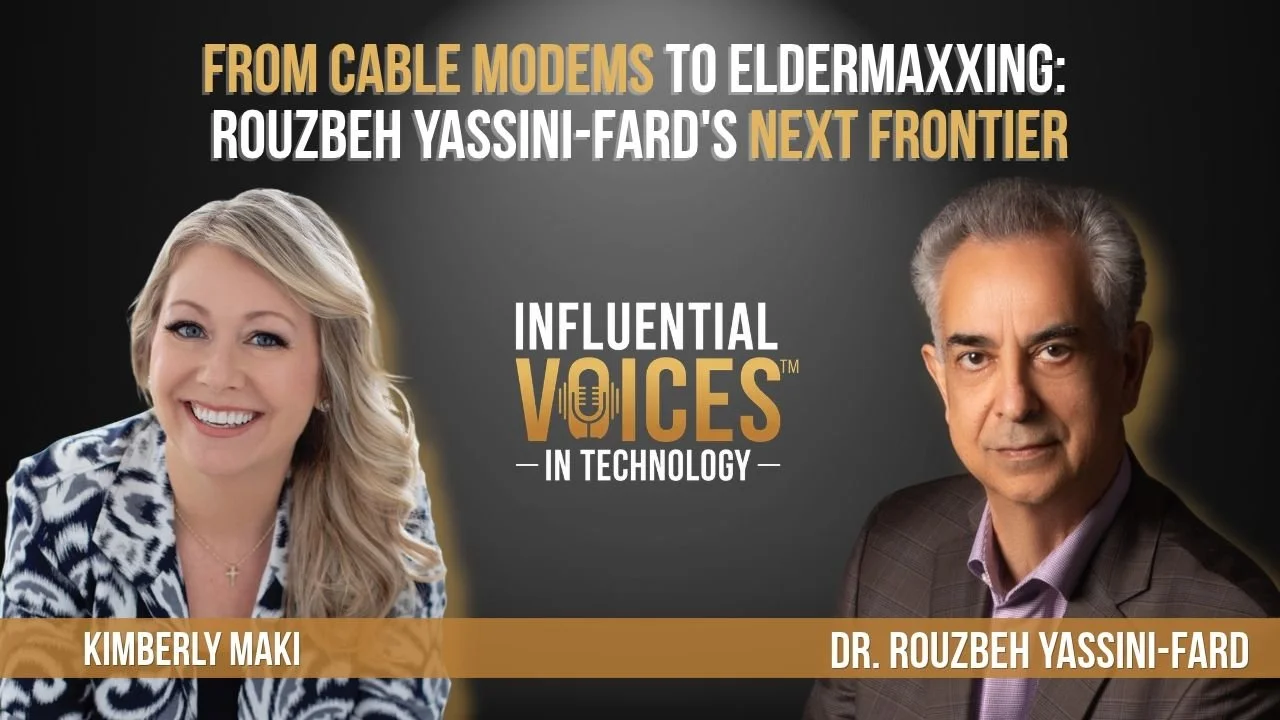
From Cable Modems to Eldermaxxing: Rouzbeh Yassini-Fard's Next Frontier
What if the technology that transformed how we connect could also transform how we age?
Dr. Rouzbeh Yassini-Fard, widely known as the father of the cable modem, helped bring broadband connectivity into millions of homes. Today, he's turning his attention to another challenge: how technology, healthcare innovation, and connectivity can help our elders live healthier, more independent lives in the homes and communities they love.
Through the YAS Foundation, Rouzbeh is advancing a vision he calls eldermaxxing, an approach that brings together technology, medical expertise, and personalized information to help people thrive as they age.
In this conversation with Kimberly Maki, Rouzbeh shares how his own family's experiences inspired this work, why our approach to aging needs to evolve, and what lessons from the broadband revolution could help make innovative eldercare solutions more accessible and affordable.
In this episode, you'll discover:
The four Ps of eldermaxxing: Predicting, preventing, personalizing, and participating, and how they could reshape the experience of aging.
Beyond wearables and health snapshots: Why connected devices alone aren't enough and how combining health information with medical expertise could provide a more complete picture.
Turning information into insight: How Rouzbeh's Home and Thriving work has explored making complex medical records more useful for physicians, families, and caregivers.
Independence, dignity, and privacy: How remote monitoring could help elders remain at home while maintaining control over who can access their personal information.
The growing caregiver challenge: Why demographic changes and a projected shortage of caregivers make new approaches increasingly urgent.
Lessons from the cable modem revolution: How collaboration, standardization, and economies of scale could help make connected eldercare technology more affordable.
Innovation through collaboration: Why Rouzbeh is sharing ideas and prototypes with universities and hospitals, and how healthcare organizations, entrepreneurs, and government can contribute.
From the infrastructure that connects our homes to the technologies that could help us thrive within them, this conversation explores an important question: How can innovation serve not just longer lives, but better lives?
Influential Voices in Technology™ — Where Technology and Infrastructure Empower Human Potential.
In Memory of Roger Brown
This episode is dedicated to the memory of Roger Brown, whose early storytelling helped bring the cable modem revolution to the attention of the broadband industry. As Rouzbeh reflects in this conversation, communicating the possibilities of innovation can be just as important as developing the technology itself.
RESOURCES
Dr. Rouzbeh Yassini-Fard — YAS Foundation
The Accidental Network: How a Small Company Sparked a Global Broadband Transformation
Dr. Rouzbeh Yassini-Fard on LinkedIn
Kimberly Maki — Influential Voices in Technology™
Kimberly Maki on LinkedIn
MEET OUR GUEST
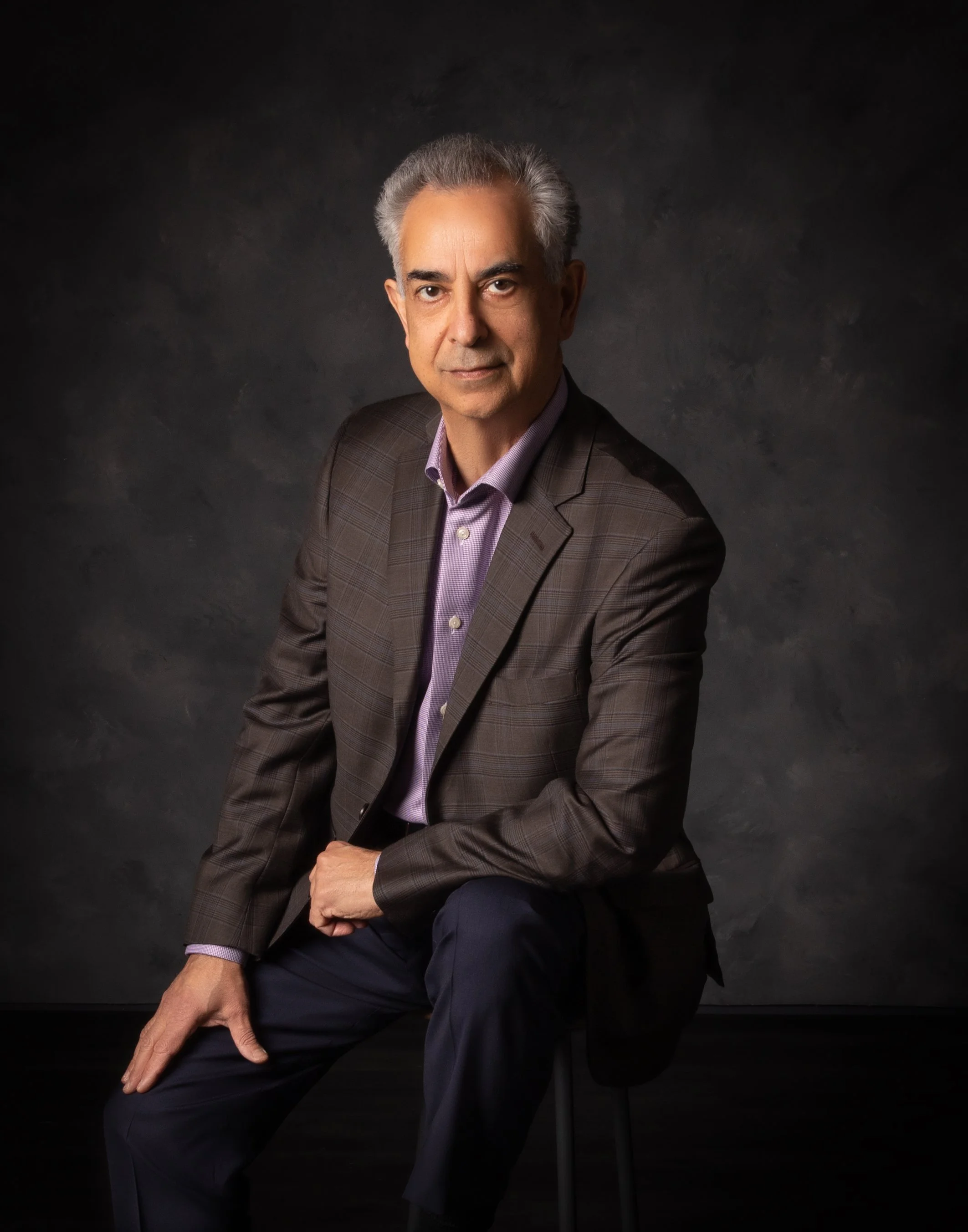
Dr. Rouzbeh Yassini-Fard, Founder, YAS Foundation
Rouzbeh Yassini-Fard is a technology entrepreneur and philanthropist whose Massachusetts-based organization, YAS Foundation, supports innovation and creativity addressing medical technology, telecommunications advocacy, educational scholarship and cultural collaboration.
Dr. Yassini is widely known as the “father of the cable modem,” tracing to the breakthrough achievements around high-speed data technology pioneered by LANcity, a company Yassini founded in 1988. LANcity was the developer of Cable Modem and its key core technologies including a Media Access Control software solution which Yassini contributed on a royalty-free basis to the global cable telecommunications industry (Broadband revolution.)
In 2024, Yassini was inducted into the Syndeo Institute’s Cable Hall of Fame, joining numerous notable industry luminaries and trailblazers. The same year, he was selected to receive an Emmy Award for Technology and Engineering from the National Academy of Television Arts & Sciences.
Yassini also is Executive Director of the University of New Hampshire Broadband Center of Excellence, an interdisciplinary initiative devoted to the advancement of broadband Internet technology and services. Yassini holds an Honorary Ph.D. in Science and a B.S. in Electrical Engineering from West Virginia University; an Honorary Ph.D. from Merrimack College; and an equivalent MBA from General Electric’s Financial Management Program. Dr. Yassini is a member of the Lane Department Academy and the West Virginia University Academy of Distinguished Alumni.
Dr. Yassini is the author of The Accidental Network published in the fall of 2025, How a small company sparked a global broadband transformation. He has also authored Planet Broadband (Cisco Press, 2004), a humanized look at broadband technology and its contributions to society.
He resides in Massachusetts.
-
This transcript was automatically generated for your convenience. Please forgive any typos or misspellings.
Kimberly Maki:
Welcome to Influential Voices in Technology, where we explore how technology and infrastructure empower human potential. Today, I’m joined by someone whose innovations helped change the— how the world connects.
Dr. Rouzbeh Yassini-Fard is widely recognized as the father of the cable modem. His pioneering work helped bring broadband into millions of homes, transforming how we communicate, work, learn, and live.
But today, Rouzbeh is focused on a different kind of connection, one that could fundamentally change how we care for our elders. Through the Yass Foundation, he’s advancing a vision for helping elders live healthier, more independent lives in their own homes, supported by technology and the communities around them.
It’s a deeply personal mission and one that raises important questions about how we value and care for our elders in America. Rouzbeh, welcome to Influential Voices in Technology.
Dr. Rouzbeh Yassini-Fard:
Thank you, Kimberly, for giving me an opportunity to share what I have experienced in the last 10 years after the broadband deployment worldwide. I appreciate your time and opportunity.
Kimberly Maki:
Thank you. So Rouzbeh, you’ve already helped transform how the world connects, but when we last spoke, you made it clear that you’re now focused on something even bigger. Equally important to you.
What inspired this next chapter of your life? And why is it so personal?
Dr. Rouzbeh Yassini-Fard:
Well, that’s an excellent question to start this conversation. So, you know, we are living in a world that since World War II, for the first time, the people who are on planet Earth living more than average age of 78.
In fact, if with some good diets and some good care, we could have our first generation of the millennium to live up to 100 years. This is the first time in the history of mankind that average age can be up to 100 years. On the other side, you will notice that our best 30, 40, 50 years is ahead of us as we retire.
But we as a community, we as a government, we as a society are least prepared to take care of our elders and have them quality of life with the pride and the value that they can thrive their life.
So what does all that mean? That all means some of our most best contributors who brought our community and society to where we are, are really left alone to independent living and nursing home with waiting to pass away, not necessarily enjoy the majority part of their life.
That has come to me very clear as my elder parents have aged and my uncle had aged and the community that had been around me has aged. And when I travel to this independent living and sometimes nursing home, I really feel that America can do a lot better for our elders than what we have given them so far.
That’s the motivation behind why I want to carry the broadband infrastructure that we innovated to become actually part of a solution to do for our elders what we did for younger generation, which are now connected community.
Kimberly Maki:
Wow. Yes, it’s so important and deeply personal. So we have more technology, more connectivity, and more medical knowledge than at any point in history. Yet you believe we’re still falling short in how we care for our elders and your personal Your personal experience has certainly shown that.
So, what are we getting wrong? And, why do you think we’ve actually allowed that to happen?
Dr. Rouzbeh Yassini-Fard:
That’s a great question. What has happened, our biological age is 10 to 12 years ahead of our physical age. How did that happen?
That happened because of the fast food restaurant, that happens because of Lack of care that we provide to ourselves while we are working at age 20 to 65. That happens because we go to doctors only twice a year, maybe, to get some biometric measurements to be done. We don’t really have a digital profile of our health and a digital awareness of what our body doing at this point.
So, Having said all that, the question becomes to be, do we have the technology? The technology is there in the piece-by-pieces, but technology is not integrated in a platform that we can look at 40 to 50 biometric parameters, plus my MRI result, plus my gene sequencing, where my doctor dynamically can look to see how my biological age is changing versus my physical age.
And this is the gap that I hope to be able to fill through my lectures, through my communication with the intellectual people in our country, and through developing some prototypes that can do that.
And guess what? When we talk about prototype, we actually use some of those for my own family. And there’s a profound result where you go see with the doctors and talk with them to say, hey, by the way, I have this latest information for you.
Why is that important? Because my doctors, your doctors, our friends’ doctors look at our parameters twice a year, maybe 4 times in a year. This way, through a normal understanding of the broadband pipeline on one side, a platform of software on the other side, we can actually interconnect them together where for the first time we have daily, if not hourly, if not every minute response to our body parameters.
This will help to really bring our elders, and for that matter, once we solve the problem, our younger generation, for the first time, with a digital profile of their health, which I’m hoping that assists us to reduce our biological age, where our biological age is far less than our physical age, and that brings the longevity and equality of life.
Kimberly Maki:
So you’re using the term eldermaxing. To describe a broader vision, what does eldermaxing mean to you, and how does it take the idea of aging in place to a whole nother level?
Dr. Rouzbeh Yassini-Fard:
I appreciate using my word of eldermaxing. To me, eldermaxing means 4 things: predicting, preventing, personalizing, and participating. What does those 4 P mean?
Predicting means we can predict the illness and disease. The preventing means reduce and eliminate unnecessary trip to the doctor’s office and emergency room every 90 days after something has happened to you. Personalizing means every individual is measured based on their own personal capabilities of the parameters that impacts them.
And participating means you get your advocates, your family members are proactive with you, that if and when you decide they have to be part of this equation, they can know exactly quantitatively versus qualitatively that how you are doing, how you are not doing in that nature. To me, those 4 elements makes eldermaxing parameters move forward.
And as a result, personally, I have seen when I’ve experienced those And my own, I’m a diabetic type 2, and when I use all those parameters for myself, I’ve been able to eliminate number of my medications and be able to reduce my A1C from upper ends to the lower ends of the number. So these parameters works well and available.
However, you need to have the platforms and algorithms and what I call the dashboard that make them meaningful for the doctors who don’t have time your advocates who might be having traveling or other things to do, and for your caregivers. So what we try to do to bring those 4 elements into useful tools for everybody else.
Kimberly Maki:
Well, I really do like the Elder Maxing. You’ve actually put it kind of in a framework that can be accessible. So I think that’s super important.
So also, you just mentioned that we do have an extraordinary array of technologies. So, you know, from health monitoring wearables and smart home to telehealth and artificial intelligence, yet most of these technologies operate independently of one another.
So what’s preventing us? What’s actually preventing us right now from bringing them together into something that actually works for our elders?
Dr. Rouzbeh Yassini-Fard:
You know, Kimberly, somewhere in the last few decades, we lost valuing our elders. And sometime in the last few decades, we forget that using these sensors or using the remote monitoring alone by itself is not going to do anything for us except confusing us.
And we have an image of, because I’m measuring certain parameters, I’m good. That’s what could be true. You measure some parameters, but if you’re not bringing them holistically all together with the medical doctor’s background behind it, it doesn’t mean anything.
For example, on your biometric parameters, when 6 or 7 or 8 of your biometric parameters changing simultaneously one way or the other, or when that your own doctors look at some of your genetic characteristic of you versus me versus someone else. versus cognitive behaviors that we might have or we might not have.
If all those comes together at the same time, it’s a whole different image of how our health is doing and how we aging than just saying, I took so many steps or my blood pressure is XYZ, therefore I’m okay.
So the reason we have failed is because those multiple parameters has not come together and has not been matched with our medical expertise. That means our medical doctors don’t know as much about the technology, our technology guys don’t know as much about medical, and our government— you look at executive office, there’s 41 people reporting to the Office of President, not a single one of those people knows technology.
We have 400+ members of the Congress, not a single one of them are engineers. And our senators are the exact the same way. And when it comes to judiciary system, we don’t even have those who understand how the people age and what law they need as their age.
As a result, we need to really culturally shift everybody up that elderly aging process should be among the top 20, if not top 10, if not top 5.
The reason for that is Even though our new generation is the most connected, but our loneliness generation of the lifetime, because the head is on the screens and not many else. Our elders who have all this life experience and have a lot of valuable knowledge can actually bridge this loneliness that they have and the younger generation has together and bring us to the next level.
So, what this platform will do for the elders is enables them to be feeling younger, thrives better, and enjoy life at age 60, 70, 80, 90, 20— not 100, and bridge them to a younger generation to come together.
For example, you know, from age 60 to 80, there’s no reason we have faced number of the chronic diseases that we are. So, if you have a digital profile of our health, If we have thinking about this in a preventive way, we can do magic for our lives and our community and our society in general.
So that’s the whole platform behind where we are coming from.
Kimberly Maki:
And so I wanna go back to one of the most interesting possibilities I think that, you know, technology that you mentioned could help us is to recognize the subtle changes in our health before they become serious problems.
And you’ve already explored this through your home and Thriving Initiative. What did you learn and what does it tell you about the possibilities ahead for all of us?
Dr. Rouzbeh Yassini-Fard:
You know, firsthand, Kimberly, some of our elders, some medical records are 12, 14, 15, 16 inches of the documents. The doctors in the doctor’s office and the hospital don’t have time to look at it. The elderly by themselves don’t remember where those records are. And the advocates have no idea how to use that information to provide the better cares.
But if you use artificial intelligence as well as these records in a meaningful way, when an elder has foot problems or has a headache or has shoulder issue, there’s only a small minor of this data that is really important for the doctors to know at the time.
But unfortunately, majority of our elders who live in the independent living or nursing home or with their loved ones don’t really have those information to provide to their doctors at the right time, in the right place to get the right care.
My personal experience in the last 10 years, when I collected that and when I filtered it and when I able to isolate it and encapsulate it to nuts and bolts, The doctors loved it. They know exactly why the elders coming to their office with that pain means and what the historical elements are.
That information in our hand. So you and I have our personal entertainment in our hand. You and I have our most beautiful clothes in our hand, know exactly where it is. But when it comes to our health, nobody knows anything.
So the idea to bring all that in the forefront. for the healthcare system and for our caregivers and for advocates that they’re all working from the same page.
This is just like a football game that we watch nicely on Sunday. The coach has a play game for every time or every minute of the 4 quarters, how to go and get a touchdown. But when it comes to our health, we have no playbook. So— Mm-hmm.
Eldermaxing and the goals of these data is to really make it proactive and make it available at the time that the person needs with their knowledge of who their advocates are and where the advocates can use that information for them.
Kimberly Maki:
You know, I actually have a wearable that I use as well. And I remember recently it changed ownership and there was a lot of, without mentioning what one it is, there was a lot online about privacy.
And so I’m thinking about all this connected Technology and the privacy questions and independence. So some people might hear this and hear our discussion and wonder whether we’re talking about technology monitoring their every move.
You know, how do we make sure that technology supports our elders’ independence rather than intrudes on it?
Dr. Rouzbeh Yassini-Fard:
You know, the remote monitoring that’s being done for a number of the reasons. It’s a positive thing as long as the person who’s being monitored is in charge of it.
And, and positively saying that, every element that we bring to a smart home, every element that bring to your wearable, every element that bring to the dashboard, every element that shares with your caregivers and your advocates, is in the 100% control of the individual elders. That means they can decide who can seize it, who can play with that information, who can do what with it.
In fact, number of the wearables which come from some highest brand secure your data in the most efficient way that is only in your personal device hand, and no one else can see that unless you enable and allow them to do that.
So we live in America. We live in the best country in the world when it comes to information and knowledge. We have encryption technology. We have authentication knowledge. We have a lot more of those elements around.
So these elements being available at the home, in the smart home, that elders can live with their loved ones and grandchildren and the parents and also on, really does not mean we are violating their privacy.
But what we are doing for them is that someone is looking for them 7 by 24, and their life can go on because their children could be on the road, they could be in a movie place, they could be traveling.
But as long as they have access to all that information, for example, let’s say a person gets up in the at nighttime eight times. The norm is two times. Now. alarm goes out that indicates your mother just woke up 6 times more today than the day before. That might mean nothing in one end, or on the other end means she might be uncomfortable.
Because you have that data, because you have that alarm, because she allows you to see that, you can call mom and say, mom, is everything okay? Are you all right? Why did it happen?
And by talking with her, looking at her cognitive, looking at her face, you could actually decide if I have to take an action or not. Otherwise, she might not be able to even communicate that, oh, son, I got up 6 times more today than the day before.
That’s how we’re trying to make this thing personalized. And that’s how we’re trying to make that practical.
Kimberly Maki:
So this seems so incredibly important to society as a whole. So I want to talk a little bit about making innovations like this accessible to everyone.
And a lot of people might not know this about you, but when you helped pioneer the cable modem, your company contributed patented technology royalty-free to help establish an industry standard. That decision helped make broadband more affordable and accessible to millions of people.
And today we have extraordinary technology technologies that could help our elders live healthier, more independent lives, but many of these solutions remain expensive, fragmented, as you just mentioned, you know, previously, and perhaps maybe out of reach.
So what will it take to make these technologies affordable and widely available to all elders, not just those who can afford them today? And Can we apply some of the same lessons that you learned, uh, really from the broadband revolution that you enabled, uh, to make this next leap happen?
Dr. Rouzbeh Yassini-Fard:
Yeah, Kimberly, excellent way to bring this, um, solution together. So there’s 4 things that needs to happen.
Number one, our governments needs to understand that the life of elders matters and driving them for better quality of life with their loved one, it will reduce the cost of Medicare, reduce the cost of the elderly care significantly, and helps our budget to be balanced. These 2 are dependent. They’re no longer independent.
So our government needs to understand that, and legislation needs to pass in order to allow this type of technology to become— to be ubiquitous, number one.
Number 2, Our entrepreneurs and medical teams need to work in interdisciplinary way and to integrate this technology faster, better, cheaper. And that’s where the startup and venture capitalists can help to accommodate that. Once this global market— we’re going to have 2 billion people over age of 60 by year 2030. This is a huge market that could be applied. So that’s the second piece.
The third piece is People like myself and others, we are evangelizing this solution and providing what we have learned, what we have developed in prototype, available at no cost to the universities, to the hospitals, to be able to bring that.
Last not least, a healthcare system methodology needs to have to change. I apologize by saying this, but I talked with a number of the hospitals, and what they tell me is, Ruzbeh, you’re trying to bring preventive and prediction to the elderly’s health. We don’t like that because our business model is for people to get sick, to come to the hospital, to stay there for 3 to 4 days, then we discharge them and send somebody to their home to take care of them. And that way we make money.
If the people don’t get sick, we don’t make any money. Therefore, prediction and prevention is not the priority for us. That’s a wrong healthcare model in place.
So when you bring these 4 together in a platform where this top priority for us, that’s as affordability or as the price of gas is, then all of a sudden people will wake up.
Just remember, in 1960s, it used to take 4 people to take care of 1 elder. Today, we only got 2.7 people working to take care of that elder. The dollars and the cents, it tells you that we need to come up with a different working physical model to take care of our elders.
And we have the technical solution. We have the visions of how this thing needs to work. We have a prototype that is showing how the benefits are. All we have to do is get it mobilized.
And that’s exactly what we did with our broadband standardization. If you remember, you know, we created the LAN city, we created the cable modem, then thanks to CableLabs and cable industry, We brought all that to the standardization with the vendors industry. And guess what? The $18,000 cable modem could cost as low as $30.
I have no doubt we can do the same thing for the healthcare. We just need to make it a top priority for our legislative and executive branch to look at the value of the life of our elders.
Kimberly Maki:
That’s why I think it’s so important that I’m talking with you today, Rouzbeh. You helped pioneer a technology that changed The world. And now, you are personally working towards something that can revolutionize how we live as we age.
So, if we’re having this conversation 10 years from now, what would you hope has changed for our elders? And maybe that’s kind of a given, but what would maybe make you feel that this next chapter has been successful?
Dr. Rouzbeh Yassini-Fard:
You know, um, we are about 3.4 million caregivers short by the year 2040, and we are about 1 million houses short for the elders to be able to go to the independent living and nursing home. Those numbers are huge, and nobody is really building toward solving those items, but technology can, you know.
And, uh, What I’d love to see 10 years from now, that the millennium, the guys who were brought up with the wearables and the variety of their remote monitoring, that they’re actually now aging in their own home, in front of their family, with their loved one, and using this type of technology fully, where we don’t need to really rush them to independent living or nursing home. or get extra caregivers to come to them.
All this can be done if we plan it now. We got a good 10 years ahead of us to have the millennium for the first group of our generation will be taken care of and age with pride, age with quality, and age with reliability, and age longer than we have ever seen our own parents. To me, that’s extraordinary.
You know, some entrepreneurs and like to make billions and delegate money and get recognition. I’m exactly reverse of that. I really like to put my own intellectual and knowledge and IPR for free for the world to use. To me, that’s the highest reward.
And there’s a number of the people like me around that can do the similar thing, but we need the mobilization. And I think because of the healthcare is managed by the government, we need to get our elected official to put this at the top priority.
elders’ lives matters. Elders’ life goes to 100 years, and we need to be prepared to thrive for quality and the value that they bring to the society based on their experience and based on the love they have for grandchildren and so on. So that’s what I’m hoping happen 10 years from now.
Kimberly Maki:
Rouzbeh, I am deeply grateful for the time that you spent with us today, and I want to thank you for sharing this deep vision and the personal conviction behind it.
What I find especially compelling is that the technology you helped pioneer decades ago may now become part of the foundation for something equally transformative, which will be helping our elders live healthier, more independent lives surrounding, you know, surrounded by the people and communities they love. And actually, I’m in that community as well.
So your story reminds us that innovation isn’t simply about what technology can do. It’s about what we choose to do with it.
Dr. Rouzbeh Yassini-Fard:
Thanks, Kimberly, for the opportunity, and I appreciate taking time to bring these most important elements of our our life to a surface that people can see. People like you can help and communicate.
I want to share a personal story. Roger Brown was an individual back in 1989 that I first informed regarding the cable modem. He wrote a lot of good things about cable modem. Mm-hmm.
And through his powerful pen, we were able to get attention in our industry by 1992, what the cable modem and broadband is, because at that time, the people indicated, why would I need broadband? Nobody has computer at home. Right.
This is the same story. Why do I need the technology to monitor and manage the health of the elderly at home? Because it will help and assist to build this better society and better community.
So I hope through your pen and through your podcast, we can bring the same revolution back that we started the broadband and bring the healthcare to the elderlies in the most Actually,
Kimberly Maki:
in bringing Roger’s name back into sequence here, I just want to say we should dedicate this podcast today to his memory. And thank you for bringing him up again because he was foundational in helping make that story come to life.
Dr. Rouzbeh Yassini-Fard:
I love that. That’s a great idea. Thank you so much, Kimberly. Have a lovely day.
Kimberly Maki:
For listeners who want to learn more, we’re going to include information about the Yass Foundation and Rouzbeh’s book, The Accidental Network, in our show notes. We’ll also be sharing a link to his Home and Thriving presentation that he has made available, as well as a link for his vision of eldermaxing.
And I really do hope you will join us in this quest to make our lives better and all of the elders— I mean, really to actually support the elders in our community, those who came before us.
So thank you for joining us on Influential Voices in Technology, where technology and infrastructure empower human potential.
Watch on YouTube • Listen on Apple Podcasts • Listen on Spotify
Related Episodes
Enjoyed this episode?
Explore more conversations about technology, infrastructure, energy and opportunity.